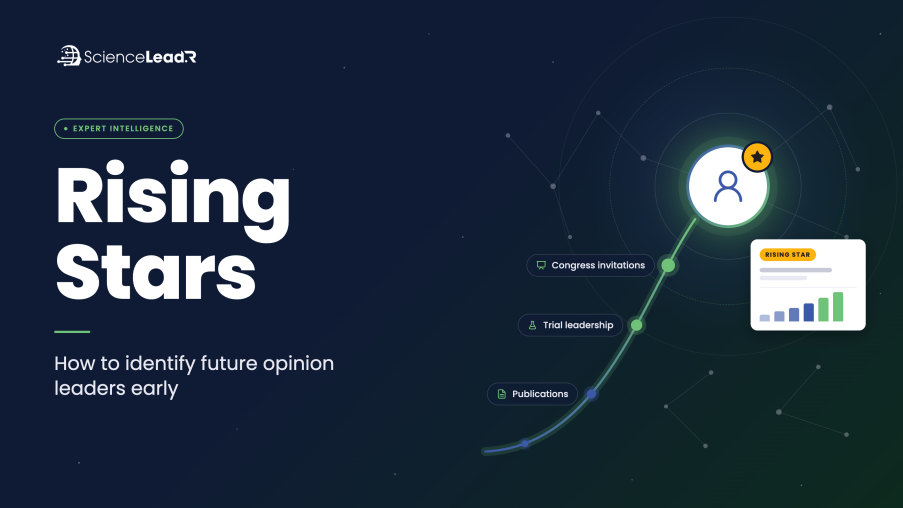
EXPERT INTELLIGENCE / RISING STARS
A practical guide for life sciences teams looking for emerging expertise in their next scientific collaboration.
Your team is preparing an advisory board for a new indication and wants to identify future opinion leaders early. The established key opinion leaders (KOLs) or key external experts (KEEs) have already been identified through a search using multiple criteria. You are now seeking additional expertise, a wider range of perspectives and a multidisciplinary focus: the investigator building experience in a new patient population, the researcher advancing a promising biomarker, or the clinician connecting research with an unresolved challenge in practice.
Emerging experts and rising stars can make valuable contributions while their wider reputation is developing. The challenge is to identify these experts early and develop the relationship over time.
THE EARLY DISCOVERY APPROACH
To detect future opinion leaders early, track how relevant scientific contributions, research responsibility and peer recognition develop over time. Bring together evidence from publications, trials, congresses and professional networks, then use scientific review to assess who merits closer attention.
For Medical Affairs, clinical development and scientific partnership teams, this approach can broaden the pool of collaborators and make expert selection more closely reflect the questions a project needs to answer.
What makes a scientific expert a rising star?
A rising star is an emerging expert whose work shows growing contribution, independence and recognition within a defined scientific area or therapeutic indication.
Career stage provides useful context. So do the opportunities available within a specialty, institution or country. An age cutoff, a prestigious affiliation or a single highly cited paper leaves much of that context unexplored.
The key question is how the person’s contribution is evolving and whether it is relevant to your scientific objectives.
Why established rankings need a forward-looking view
Lifetime publication counts and h-indices describe accumulated achievement. Emerging researchers have had less time to build those records.
There are also limits to using cumulative metrics to forecast future performance. A study by Penner and colleagues in Scientific Reports found that models predicting future h-index could overstate their predictive power, with the least accurate estimates occurring for younger researchers.
For industry teams, the practical implication is to examine recent activity, individual contributions and peer recognition alongside established reputation. Use the following five signals to guide that assessment.
How to identify future opinion leaders: five signals and how ScienceLeadR can help
01 / Scientific momentum
Sustained progress in a relevant scientific topic
Start with the work itself. Is the researcher developing a coherent programme in the disease subtype, mechanism, epidemiology, data generation, clinical trials, technology or clinical question that matters to your team?
With ScienceLeadR, you can explore recent original research and review its methods and contribution. The platform brings each expert’s indexed publications together, with data sourced from PubMed, the biomedical and life sciences literature resource, and OpenAlex, an open catalogue of the world’s research.
02 / Research ownership
Increasing responsibility for the research
A publication list becomes more informative when you understand what the person actually did.
A researcher progressing towards independently led projects gives your team a concrete development to examine. This can help identify candidates for scientific advice or further investigator assessment.
With ScienceLeadR, you can review authorship positions, grant responsibilities and documented trial roles. First, last or corresponding authorship can prompt further investigation. Where available, examine contribution statements in the underlying publications to clarify ownership. The CRediT contributor role taxonomy provides a useful framework for understanding contributions such as conceptualisation, methodology and supervision.
Interpret journal impact factors as journal-level context alongside the expert’s individual contribution. In clinical research, distinguish responsibility for an individual site from leadership of the overall study, and check the documented scope of any principal investigator (PI) role.
03 / Peer recognition
Growing recognition from scientific peers
Look for evidence that others increasingly seek the expert’s contribution: invited scientific presentations, congress moderation, society working groups or requests for methodological advice. An independently selected scientific invitation, a submitted abstract and a sponsored speaking engagement represent different forms of participation.
With ScienceLeadR, you can assess the conference ecosystem and review an individual expert’s congress activity. Are they speaking at national or international congresses? Chairing sessions? Presenting late-breaking study results or posters? Invited to speak at industry symposia?
04 / Collaboration reach
Collaboration extending across groups and institutions
Examine how the researcher’s collaborations are developing. Are they contributing to studies beyond their home department? Working with new institutions? Bringing clinical and methodological expertise together?
With ScienceLeadR, you can visualise the expert’s collaboration network and explore the questions that matter to your project:
- Do they collaborate mainly within their institution, nationally or internationally?
- Which institutions and research groups do they work with?
- Would their experience broaden the scientific perspectives or geographic reach of your advisory board or project?
05 / Emerging questions
A contribution to an important emerging question
Future relevance depends on the scientific problem as well as the person.
Consider a researcher developing a method for a difficult-to-study population, investigating a new diagnostic approach or generating real-world data. Their expertise may be particularly useful to a specific project while their wider profile is still growing.
With ScienceLeadR, you can explore the evidence behind an expert’s work and use it to assess what their research adds, how robust the evidence is and which questions remain open. Grants, patents and new study activity can provide additional context where relevant to the field, helping your team identify emerging innovators and potential future leaders in a particular topic.
Turn the signals into a shortlist your team can explain
Begin with a precise brief: the indication, scientific question, geography and purpose of the collaboration. An advisory board and a clinical study require different evidence of suitability.
Then use a consistent review process:
- Review change over time. A rolling 24–36-month window is a practical starting point for recent activity, adjusted to the pace of the field and interpreted alongside earlier work.
- Compare relevant peers. Account for specialty, career stage and research opportunity. Follow the San Francisco Declaration on Research Assessment (DORA) recommendation to assess research on its merits rather than use a journal’s impact factor as a substitute for an individual’s contribution.
- Check the underlying records. Confirm identity, affiliation, dates and roles. An abstract, presentation and paper may describe the same study; recognise the shared origin when weighing the evidence.
- Add scientific judgement. Ask a therapeutic-area reviewer to examine relevance, contribution and gaps. Treat missing records as uncertainty requiring investigation.
- Set the next review point. Refresh the assessment after a major congress or at a suitable planning interval. Record what changed and whether it affects the case for consideration. Use those updates to prepare relevant follow-up discussions as the expert’s scientific interests develop.
The output should explain why each person is relevant, what evidence supports their inclusion and what still needs checking.
ILLUSTRATIVE EXAMPLE
What this looks like in practice
Imagine a researcher with a modest lifetime citation record who has recently led two relevant studies, taken responsibility for a new clinical investigation and received an invited congress role.
That combination gives a Medical Affairs team several developments to investigate. Reviewing the work may establish that the researcher brings a useful perspective on an evidence gap planned for an advisory board.
The immediate value is a relevant candidate backed by a clear rationale. Future prominence remains uncertain, while the case for a scientific conversation can be assessed today.
How ScienceLeadR supports Rising Star discovery
ScienceLeadR brings publications, clinical trials, grants, patents and congress activity into a connected knowledge graph linking experts, institutions and scientific topics. Its capabilities include Rising Star detection, expertise mapping and collaboration network analysis. Explore how ScienceLeadR connects scientific activity with expert discovery.
Its Rising Star approach uses the Science Leader Reputation (SLR) score to analyse early scientific activity across multiple dimensions of contribution.
FOCUS YOUR SEARCH
With ScienceLeadR, you can select the period you want to review. For example, use the search bar to look for experts whose first indexed publications fall within the past 10 or 15 years. Combine this with Medical Subject Headings (MeSH), specialties, countries and SLR status to identify suitable rising star candidates for your project.
For life sciences teams, this provides a basis for discovering emerging experts, examining the activity behind their profiles and assessing relevance to a specific scientific brief. A shared evidence base can support discussion between Medical Affairs, clinical research and partnership teams as they consider potential collaborators.
YOUR NEXT SCIENTIFIC COLLABORATION
Find emerging experts for your next project
Bring your next indication, scientific question and target geography to a ScienceLeadR demo. Explore emerging experts and the evidence behind their relevance to your project.
External references and resources
- Penner O, Pan RK, Petersen AM, Kaski K, Fortunato S. On the predictability of future impact in science. Scientific Reports. 2013;3:3052. DOI: 10.1038/srep03052.
- U.S. National Library of Medicine. About PubMed.
- OpenAlex. The open catalogue of the world’s research.
- NISO. Contributor Role Taxonomy (CRediT).
- DORA. San Francisco Declaration on Research Assessment.
- U.S. National Library of Medicine. Medical Subject Headings (MeSH).