KOL identification and mapping helps life sciences companies, including pharmaceutical, biotech and medtech organisations, find the right experts for scientific projects such as advisory boards and clinical trials. For Medical Affairs and clinical development teams, the goal is a clear view of who has relevant expertise, experience and networks, what supports their reputation, and which collaborations could advance their scientific objectives.
The right expert depends on the scope of the project. An advisory board evaluating a molecule’s potential place in a treatment pathway may need a different mix of people from a clinical trial steering committee. A global research leader with an extensive academic network, a clinician with an intimate understanding of patient pathways, and a specialist with deep knowledge of disease mechanisms can each bring something essential.
This guide explains how to identify indication-specific experts, assess their scientific contributions and map their collaborations. It also shows how ScienceLeadR connects these tasks through evidence-based scientific intelligence.
What is KOL identification and mapping?
A key opinion leader (KOL) is an expert whose knowledge, experience and professional standing make their perspective influential within a particular community.
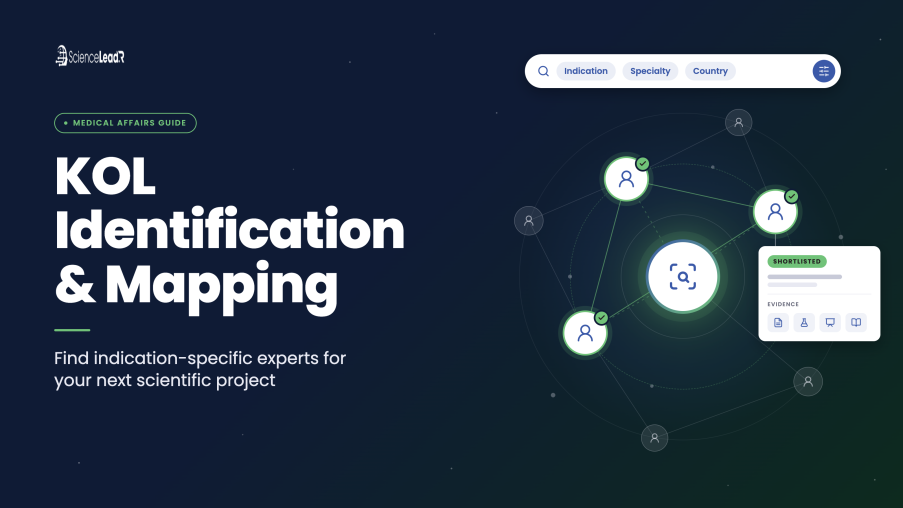
KOL identification finds experts relevant to your indication, geography and scientific objective. KOL mapping places those experts in context by examining their research topics, institutions, professional roles and collaboration networks.
Used together, they help answer three questions:
- Who has the expertise this project requires?
- What evidence supports their relevance?
- How do their connections and perspectives complement the experts already involved?
For industry teams, that understanding supports advisory board selection, investigator discovery, scientific exchange and research partnerships.
Why indication-specific expertise matters in Medical Affairs
Expertise has a scope. Someone with extensive work in a therapeutic area may have limited involvement in the particular disease subtype, biomarker or care setting your team needs to understand.
For example, a heart failure specialist focused on heart failure with reduced ejection fraction (HFrEF) may have different research experience from an expert working on heart failure with preserved ejection fraction (HFpEF), particularly its obesity-related phenotype. The American College of Cardiology’s expert consensus pathway highlights obesity as an important consideration in HFpEF, illustrating why the clinical context matters when defining the expertise required. [1]
A useful KOL assessment therefore starts with the scientific contribution you need. For an advisory board, that might be experience with an unmet need. For clinical development, it could involve studies with a relevant population or methodology, trial leadership, guideline development or regulatory development experience. For a medtech partnership, it may include diagnostic workflows, technology evaluation or implementation research.
This approach aligns with the joint APPA, IFAPP, MAPS and MSLS position statement on Medical Science Liaisons. It recommends identifying experts through relevant medical expertise, publication quality, professional responsibilities, guideline participation and research activity. [2]
Make the selection criteria explicit before reviewing names. Each candidate should have a clear reason for inclusion.
How to identify KOLs for a specific indication
1. Translate your scientific objective into a search brief
Define the indication, disease subtype, patient population and scientific question. Add the geography and type of collaboration you are planning.
For example, “cancer cachexia” is a starting point. A more actionable brief would be:
EXAMPLE SEARCH BRIEF
Experts in cancer cachexia with work on muscle wasting, screening and nutrition, alongside medical oncologists specialising in non-small cell lung cancer (NSCLC), across selected European healthcare settings.
Agree which specialties and areas of expertise are essential, and which would add a complementary perspective. This makes the search easier to refine and the resulting shortlist easier to explain.
2. Search across publications, trials and scientific activity
Build the candidate pool from several sources, with a clear purpose for each:
Evidence sources for KOL identification and mapping
Publications
What to examine: Indication relevance, methods, individual contributions, first- or last-author position, and journal context.
Why it matters: Evidence of scientific expertise and contribution to the topic.
Clinical trials
What to examine: Principal or national investigator roles, Data and Safety Monitoring Board (DSMB) experience, and clinical events committee responsibilities.
Why it matters: Relevant clinical research experience and clearly documented responsibilities.
Congress programmes
What to examine: Presentation topics, invited roles, chairing and moderation responsibilities.
Why it matters: Participation in current scientific discussion.
Editorial and academic society positions
What to examine: Editor or editorial board roles, verified reviewing activity, and society president or board positions.
Why it matters: Professional leadership and standing within scientific communities.
Guidelines and working groups
What to examine: Guideline chair roles, task force or panel membership, and working group responsibilities.
Why it matters: Formal contributions to evidence review and clinical recommendations.
Grants and patents
What to examine: Project objectives, named responsibilities and inventorship.
Why it matters: Additional context on research direction and innovation.
Conflicts of interest (COI)
What to examine: Current disclosures and relevant relationships with companies or other organisations.
Why it matters: Context for assessing potential conflicts. Confirm willingness and availability separately.
Assess the underlying contribution: author position and journal context need interpretation. DORA recommends evaluating research on its merits rather than using journal impact factors as a substitute for assessing an individual’s work. [3]
Review disclosures and capacity separately: ICMJE’s recommendations emphasise transparent disclosure of relevant relationships and activities in scientific publishing. Disclosures can inform your assessment of potential conflicts; they do not establish whether an expert is willing or available to join your project. Confirm those points directly. [4]
To map collaborations, examine shared publications, trial involvement and institutional connections. Keep the relationship types clear: co-authorship is one record of scientific collaboration, while mentoring and intellectual exchange may not appear in a publication network. [5]
Build your shortlist with ScienceLeadR
With ScienceLeadR’s KOL rankings, combine relevant Medical Subject Headings (MeSH) with country filters, then assess each candidate’s specialty and relevance to your brief. Use the SLR score to help prioritise your review, alongside the underlying evidence and your project requirements.
Review each expert’s scientific profile and augmented CV to understand their publications, clinical research activity and collaborations. ScienceLeadR brings scientific evidence into a connected platform, giving teams a shared basis for comparing candidates and discussing the rationale for inclusion.
By bringing relevant information together, ScienceLeadR supports a more systematic approach to KOL identification and mapping, helping teams organise their search and assess potential collaborators.
Find the right experts for your next scientific project
Bring your indication, scientific question and target geography to a ScienceLeadR demo. Explore relevant experts and the evidence behind their scientific contributions.
References
- American College of Cardiology. 2023 ACC Expert Consensus Decision Pathway on Management of Heart Failure With Preserved Ejection Fraction. Journal of the American College of Cardiology. 2023. doi: 10.1016/j.jacc.2023.03.393.
- Theron P, Britland M, Holder D, et al. Promoting Best Practices for Medical Science Liaisons: Position Statement from the APPA, IFAPP, MAPS and MSLS. Therapeutic Innovation & Regulatory Science. 2021;55:1139–1144.
- DORA. San Francisco Declaration on Research Assessment.
- International Committee of Medical Journal Editors. Disclosure of Financial and Non-Financial Relationships and Activities, and Conflicts of Interest.
- Patel VM, Panzarasa P, Ashrafian H, et al. Collaborative patterns, authorship practices and scientific success in biomedical research: a network analysis. Journal of the Royal Society of Medicine. 2019;112(6):245–257.