

Enrique Hernández-Lemus
Enrique Hernández-Lemus is an expert in Genetics at National Institute of Genomic Medicine (Mexico). As of September 2026, ScienceLeadR ranks Enrique Hernández-Lemus in the top 1% of experts in Mexico for Breast Neoplasms, Breast Diseases and Artificial Intelligence. Enrique Hernández-Lemus has authored 167 publications, the most recent in 2026. SLR score: 543 (community average: 125). How the SLR is computed.
LeadR Profile
Genetics
Subspecialties: Biochemistry - Nutrition - Public Health
Main Topics
Publications and Clinical Studies
Profile data updated on
Expert Rankings
Top experts on the MeSH terms this expert works on
Short Biography
Enrique Hernandez-Lemus, Ph.D. is a Principal Investigator at the Mexican National Institutes of Health and Head of the Computational Systems Biology and Integrative Genomics Lab at the National Institute of Genomic Medicine (Mexico). From April 2015 through September 2019 he was the Deputy Director of Research for Computational and Population Genomics at the National Institute of Genomic Medicine. From April 2012 to June 2022 he was Coordinator of the Computational Intelligence Program for the Center of Complexity Sciences, at the National University of Mexico UNAM.
Professor Hernandez-Lemus holds a Ph.D. in Chemical Physics (Non-equilibrium Statistical Physics - Dynamic Phase Transitions). He started his research career working in Probability Theory and Mathematical Physics. Later he turned his attention to problems in Biological Complexity and Systems Biology; has authored over 200 scientific publications and supervised the work of more than 30 students at the graduate and undergraduate level.
Dr. Hernandez-Lemus has been a visiting scientist at the Broad Institute of Harvard University and MIT, the Computational Biology Center at the TJ Watson IBM Research Laboratories; the Institute for Advanced Studies in Princeton, the Department of Physics and Mathematics at Rutgers University, the Institute of Complex Systems at the University of Barcelona and the Principe Felipe Research Center in Valencia, among others.
He has been awarded the 2016 Marcos Moshinsky fellowship in Physical Sciences. He is a member of the Mexican National Researchers’ System (Level III, the highest) and of the Mexican Health Ministry Research Network (level F, the highest). Professor Hernández-Lemus serves as a member for Latin America in the international Human Cell Atlas Consortium, is a Member of the Academic Committee of the MD/PHD program at Mexico’s National University (PECEM-UNAM). He is also a member of the Mexican Academy of Sciences, of the Mexican Mathematical Society and of the Mexican Physical Society.
Dr. Hernández- Lemus is also a strong advocate for OpenScience/OpenAccess. He is Associate Editor of Computational Biology and Chemistry and Computational and Systems Oncology, as well as Academic Editor at PLoS ONE, Scientific Reports, Computational Biology and Chemistry, Frontiers in Physiology, Frontiers in Oncology and Frontiers in Physics. Dr. Hernández-Lemus has devoted special efforts to spread the role of theoretical physics (specially statistical physics), probability theory and complex systems in the biomedical research community within his country.
Organizations
Career arc: 2006 - 2026
Number : 167
Citations
Main journals
Best Journals
Breakdown by type
Click a legend label to hide or show it in the chart.
Latest Publications
5 most recent indexed articles
Source: Pubmed
LeadR Networks
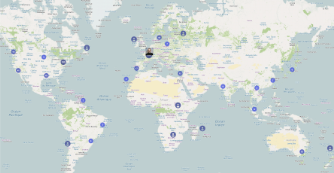
Main global connection map