

Kunal Roy
Kunal Roy is an expert in Biochemistry at Jadavpur University (India). As of October 2026, ScienceLeadR ranks Kunal Roy in the top 1% of experts worldwide for Drug Discovery, Drug Development and Drug Design. Kunal Roy has authored 375 publications, the most recent in 2026. SLR score: 1,308 (community average: 125). How the SLR is computed.
LeadR Profile
Biochemistry
Subspecialties: Toxicology - Pharmacy - Informatics
Main Topics
Publications and Clinical Studies
Profile data updated on
Expert Rankings
Top experts on the MeSH terms this expert works on
Short Biography
Dr. Kunal Roy is a Professor & Ex-Head in the Department of Pharmaceutical Technology, Jadavpur University, Kolkata, India (https://sites.google.com/site/kunalroyindia). He has been a recipient of Commonwealth Academic Staff Fellowship (University of Manchester, 2007) and Marie Curie International Incoming Fellowship (University of Manchester, 2013) and a former visiting scientist of Istituto di Ricerche Farmacologiche "Mario Negri" IRCCS, Milano. Italy. The field of his research interest is Quantitative Structure-Activity Relationship (QSAR) and Molecular Modeling with application in Drug Design, Property Modeling and Predictive Ecotoxicology. Dr. Roy has published more than 450 research articles (ORCID: http://orcid.org/0000-0003-4486-8074) in refereed journals (current SCOPUS h index 59; total citations to date more than 18000). He has also coauthored three QSAR-related books (Academic Press and Springer), edited thirteen QSAR books (Springer, Academic Press, and IGI Global), and published twenty five book chapters. Dr. Roy is the Co-Editor-in-Chief of Molecular Diversity (Springer Nature) and an Associate Editor of Journal of Molecular Graphics and Modelling (Elsevier) and Computational and Structural Biotechnology Journal (Elsevier). Dr. Roy serves on the Editorial Boards of several International Journals, including (1) European Journal of Medicinal Chemistry (Elsevier); (2) Chemical Biology and Drug Design (Wiley); (3) Expert Opinion on Drug Discovery (Informa). Apart from this, Prof. Roy is a regular reviewer for QSAR papers in the journals like Chemosphere (Elsevier), Journal of Hazardous Materials (Elsevier), Ecotoxicology and Environmental Safety (Elsevier), Journal of Chemical Information and Modeling (ACS), ACS Omega (ACS), RSC Advances (RSC), Molecular Informatics (Wiley), SAR and QSAR in Environmental Research (T&F), etc. Prof. Roy has been recipient of several awards including AICTE Career Award (2003-04), DST Fast Track Scheme for Young Scientists (2005), Bioorganic and Medicinal Chemistry Most Cited Paper 2003-2006, 2004-2007 and 2006-2009 Awards from Elsevier, The Netherlands, Bioorganic and Medicinal Chemistry Letters Most Cited Paper 2006-2009 Award from Elsevier, The Netherlands, Professor R. D. Desai 80th Birthday Commemoration Medal & Prize (2017) from Indian Chemical Society, etc. Prof. Roy has been a participant in the EU funded projects nanoBRIDGES and IONTOX apart from several national Government funded projects (UGC, AICTE, CSIR, ICMR, DBT, DAE). Prof. Roy has recently been placed in the list of the World's Top 2% science-wide author database (whole career data) (World rank 52 in the subfield of Medicinal & Biomolecular Chemistry) (Ioannidis, John P.A. (2025), "August 2025 data-update for "Updated science-wide author databases of standardized citation indicators", Elsevier Data Repository, V8, link: http://doi.org/10.17632/btchxktzyw.8).
Organizations
Career arc: 2002 - 2026
Number : 375
Citations
Main journals
Best Journals
Breakdown by type
Click a legend label to hide or show it in the chart.
Latest Publications
5 most recent indexed articles
Source: Pubmed
LeadR Networks
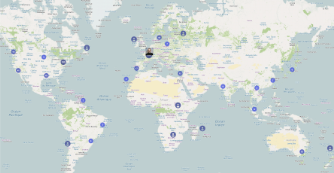
Main global connection map