
Santiago Mas-Coma
Infectiology — University of Valencia, Spain

Santiago Mas-Coma
LeadR Profile
Infectiology
Subspecialties: Public Health - Hepatology - Gastroenterology
Main Topics
Publications and Clinical Studies
Short Biography
SHORT BIOGRAPHY
Santiago Mas Coma was born in Barcelona in 1949, where he won the Extraordinary Prize of the Swiss School when he was still very young. He first followed the university 5-year-career of Biology (1972), and subsequently the 5-year-career of Pharmacy he completed in only one year (1973), meriting the Extraordinary Prize of this last degree in 1974, and subsequently obtaining the PhD degree in 1976. Full Professor of Parasitology at the University of Valencia, position he obtained after getting number 1 in the national competition at the very early age of 30 years, he launched the creation of the Department of Parasitology in the Faculty of Pharmacy and of the research team in which several members have also become well known in their professional field.
Nominated Expert of the World Health Organization (WHO, Geneva Headquarters) since 2001 and member of the WHO-STAG Committee of the WHO in Geneva during the period 2009-2014, it is in Valencia where he gets the designations of “WHO Collaborating Center on Fascioliasis and Its Snail Vectors” (WHO Headquarters, Geneva) and of “FAO-United Nations Reference Centre for Parasitology” (FAO Headquarters, Rome) for his team in 2011 and 2013, respectively, and where he continues to be the Director of both centers today. As a WHO-STAG member, he decisively contributed to the 2015-2020 WHO Roadmap of Neglected Tropical Diseases and further to the present 2030 WHO NTD Roadmap.
Well known for his numerous international connections in all continents thanks to its polyglot personality (fluent in Spanish, English, French and German) and very open minded personality, the recognitions to his overflowing activities in research and international cooperation in the fields of Parasitology and Tropical Medicine led him to be required for several positions of the highest level in both sciences, as President of the Spanish Society of Parasitology (SEP, 2003-2007), President of the European Federation of Parasitologists (EFP, 2004-2012) where he was also General Coordinator of the Parasitic Disease Threat Quick Response Committee (EFP-PDTQRC, 2012-2016), board member of the World Federation of Parasitologists (WFP, 2006-2014), and President Elect and President of the International Federation for Tropical Medicine (IFTM, 2012-2016 and 2016-2022). His long career in all these international federations, as well as in several United Nations agencies (WHO, FAO, IAEA, etc.), allowed him to expand his contacts and relations to the widest part of the world, a global frame which is at the base of his numerous investigations in collaboration with teams from very different countries.
In the Spanish Society of Tropical Medicine and International Health (SEMTSI) he was one of the five Founder Members (1998) and Vice-President (2000-2004), and the organizer of the IV National Congress of this society(Valencia, Spain 2004). He organized this congress jointly with the IX European Multicolloquium of Parasitology (EMOP 9), a macro-event of great success with the participation of 110 countries and 2,100 attendees who deserved the distinction of best congress of the year in Europe in the workshop of the European Convention Bureaux at the ICCA (International Congress and Convention Association) in 2005.
His very long teaching/training experience, not only in the universities of Barcelona and Valencia, but also in other Spanish, European, North American and South American universities, led him to launch the International Master Course in Tropical Parasitic Diseases at the University of Valencia in 1987. This multilingual course got worldwide recognition and received several distinctions and awards, both in its first period until 2005 as a WHO course (internationally recognized as the best specialty course worldwide for 15 years), and the subsequent period when already adapted to the European version according to the Bologna Convention. This course has already been implemented during 37 consecutive yearly editions.
Specialist in Microbiology and Parasitology, Mas-Coma focused his activities and studies mainly in the fields of Helminthology and human parasitic diseases, thanks to fundings obtained through numerous national and international research projects. His early steps were dedicated to fundamental research on ecology and evolution using the small mammals / parasitic helminths (insectivores and rodents) as model, especially in the situation of insularity. Later, hemoved on to the applied field of human diseases from the late 1980s. Within the broad spectrum of their research, mainly zoonotic parasitic diseases and diseases of indirect transmission by insects and molluscan vectors stand out, essentially concerning neglected tropical diseases in developing countries,
He has published more than 450 articles in scientific journals, books and encyclopedias in the fields of Parasitology, Tropical Medicine, Public Health, Ecology, Molecular Biology, Genetics and Evolution, among which more than 260 in indexed international impact journals and some of them having reached the group of 1% of the most cited articles in their discipline in a given year. His invited conferences all over the world are innumerable (more than 950 communications). All this context of great scientific production of high quality and worldwide recognition has led him to be a very cited author, with a research interest score of 7725 (according to ResearchGate) and very high rates within the field of Parasitology: A) Web of Science: h index=64; sum of citations=12094; average citations per item=46.5; B) Scopus: 69, 13954, 57.9; C) ResearchGate: 79, 19667, 52.2.
One of his articles was highlighted by the editors of the well-known “Advances in Parasitology” as the most cited throughout the 100 years of this journal (see “An Important Milestone in Parasitology: Celebrating a Hundred Volumes of Advances in Parasitology.” Adv. Parasitol. 2018, 100: 1-27).
He has been included in the 0.2% of the most influential scientists of the world in the fields of Parasitology and Mycology (1st option), Tropical Medicine (2nd option) and Biomedical Research (3rd option), and in the 0.5% of the most influential scientists of the world in the total of all disciplines (after Ioannidis et al., 2019, PLoS Biology 17, 8, e3000384).
Advisor in numerous national and international agencies in all continents, as well as of several scientific publishers, international projects, evaluation committees of different countries, Spanish and foreign institutions and centers, his long career has merited numerous awards, local, national and international medals, and distinctions, among which the title of Doctor Honoris Causa in recognition of his contributions in the field of international health cooperation in developing countries (Cluj-Napoca, 2006), in addition to the "9th Chamlong-Tranakchit Harinasuta Lecture" (Bangkok, 2003), the “Important of the City of Valencia” Prize (Valencia, 2008), the Silver Medal of the Société Française de Parasitologie (Paris, 2008), the Medal of the European Federation of Parasitologists (Valencia 2004 and Paris 2008), the recognition of "Elite Researcher in Health Sciences" (Valencia, 2010), the "Alphonse Laveran Medal" (Paris, 2017), the "López-Neyra Medal" (Santiago de Compostela, 2019), Honorary Member of the largest national society of the discipline, the British Society for Parasitology (London, 2020), and full member chosen by the Royal Academy of Pharmacy of Spain (Madrid, 2022), among many other distinctions.
His contributions to the diseases of Fascioliasis and Chagas Disease are well known. Specifically in human Fascioliasis, his multidisciplinary global contributions have completely changed the conception of this disease, which has gone from only 2,500 infected people reported in the world in 1990 to current estimates of more than 17 million affected as a result of his studies. Many of his discoveries are worth highlighting concerning etiology, transmission, epidemiology, origin and geographical spread, immunopathology, diagnosis, treatment and control. His contributions reached such an impact that WHO made the decision, for the first time, to incorporate a disease into the list of major diseases of humanitybased solely on the contributions of a single person. His regular publications with his team continue to lead the way to be followed by all the teams that investigate one or another aspect of this globally distributed disease.
Organizations
University of Valencia -
Number : 213
Citations
Main journals
Best Journals
Breakdown by type
LeadR Networks
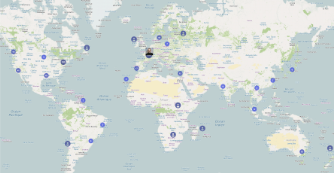
Main global connection map