 Written by
Your ORCID iD has moved from good practice to requirement. For academic physicians and life-science researchers, it is increasingly where funders and editors confirm who you are and what you have published. If the record behind your iD is incomplete, they see only part of your work.
From good practice to requirement
For NIH applications due on or after 25 January 2026, every senior or key person must have an ORCID iD linked to their eRA Commons account. Since 8 May 2026, applications with a missing link can’t be submitted (CASRAI). Publishers ask for your iD when you submit a paper, and colleagues and organisations looking for expertise use it to find your work.
The catch: keeping it complete is still manual
Most of what belongs on your ORCID record is already published and openly available. Yet adding it still means retyping it, one item at a time. For clinicians and researchers, that is time taken from patients and research, and record-keeping becomes one more administrative task fitted in between clinics, labs and teaching.
Having an iD takes minutes. Keeping the record behind it up to date takes far longer: by our estimate, 5 to 15 minutes each time you update it by hand, and much more when several publications need adding. ORCID has described this as “the endless rekeying of information that plagues researchers” (ORCID). The profiles many researchers already keep don’t help: Google Scholar and ResearchGate don’t send publications to ORCID automatically (CASRAI, Lehigh Libraries).
Why we built ORCID sync
ScienceLeadR has been an official ORCID partner since 2025, and we already do the hard part. We match more than 80 million articles, studies, grants, patents and congress records to the right people across 4.8 million expert profiles, with 98% identity disambiguation accuracy.
ORCID is the open identifier the research community trusts, and the record on it belongs to the researcher. So once you have claimed and checked your ScienceLeadR profile, you can now send that verified work to ORCID, where it serves you in every application, submission and search, not only on our platform.
It also reflects what experts told us. In our June 2026 survey, medical experts said scientific impact reaches well beyond publication counts, with leading clinical trials drawing the strongest agreement (survey results). That is why the sync carries keywords and profile links too: they describe your expertise and point to the rest of your work.
“Researchers shouldn’t have to record twice what they have already published. Our job is to make sure every paper, keyword and link is attributed to the right person. Sending that verified work to ORCID, where the researcher stays in control, closes the loop between being published and being recognised.” – Lionel Guerin, CEO, ScienceLeadR
The first week: 5,000 records
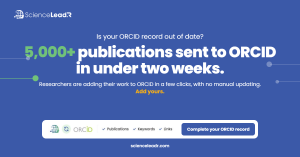
In its first week, experts used ScienceLeadR to send 5,000 records to ORCID. A sync takes under 3 minutes, keywords and links included.
| By hand | With ScienceLeadR | |
|---|---|---|
| Time | 5–15 minutes, much longer for several publications | Under 3 minutes |
| Publications | Searched for or typed in one by one | Already matched to you on your profile; you pick the ones to send |
| Keywords | Added separately | Sent at the same time, from your topics |
| Profile links | Added separately | Sent at the same time |
Manual times are ScienceLeadR estimates.
You stay in control
Nothing is sent to ORCID until you have chosen it and reviewed it. Each item carries ScienceLeadR as its source, so anyone reading your record can see where it came from, and you can remove any item whenever you like.
How to send your record to ORCID
- Log in to ScienceLeadR with your ORCID iD, or find and claim your profile first.
- Pick the publications, topics and links you want on ORCID, and review them.
- Send. The confirmation screen lists what was added; select View on ORCID to see your updated record.
Frequently asked questions
Can I move my Google Scholar or ResearchGate publications to ORCID?
Neither sends publications to ORCID automatically. If those publications appear on your ScienceLeadR profile, you can send them to ORCID from there.
Does this replace linking my ORCID iD to eRA Commons?
No. You make that link in eRA Commons. ScienceLeadR keeps the record behind your iD complete.
Can I take items off my ORCID record later?
Yes. Any item ScienceLeadR sent can be removed at any time.
Bring your ORCID record up to date
Claim your profile, check it, and send it to ORCID in under 3 minutes.