Expert insights / h-index
What your h-index says about your research, and what it leaves out.
A good h-index depends on your field and on how long you have been publishing. Two US studies of academic physicians, published in 2013 and 2014, found typical values of 11 to 16 for full professors. A score that matches your years of publishing, such as 20 after 20 years, is a solid record.
THE SHORT ANSWER
Compare your h-index with researchers in your specialty and at your career stage, and always name the database. Google Scholar gives a higher number than databases that index only selected journals, so a figure without its source says little.
2005
Year physicist Jorge Hirsch proposed the h-index
11 to 16
Typical h-index of full professors in two US studies of physicians
56
Einstein’s h-index, counting citations up to 2019
This post shows how to calculate it and what counts as a good score in medicine. It also explains why your number changes from one database to another, and how to raise yours without gaming it.
What is the h-index?
The h-index is a single number that combines how much you publish with how often those papers are cited. Physicist Jorge Hirsch proposed it in 2005 in PNAS. He wanted one figure that rewards steady, cited work. One famous paper or a long list of unread papers would not be enough.
The definition is short. You have an h-index of h when h of your papers have each been cited at least h times. So an h-index of 15 means 15 of your papers have 15 or more citations each.
How to calculate your h-index
You can work it out by hand in a few minutes.
- List all your papers.
- Sort them by citation count, highest first.
- Number them 1, 2, 3 and so on.
- Find the last position where the citation count is still equal to or greater than the position number. That position is your h-index.
Take a researcher with ten papers. Their citation counts, sorted, are 48, 33, 21, 15, 9, 7, 6, 4, 2 and 0. Paper 6 has 7 citations, which is at least 6. Paper 7 has 6 citations, which is less than 7. So this researcher’s score is 6.
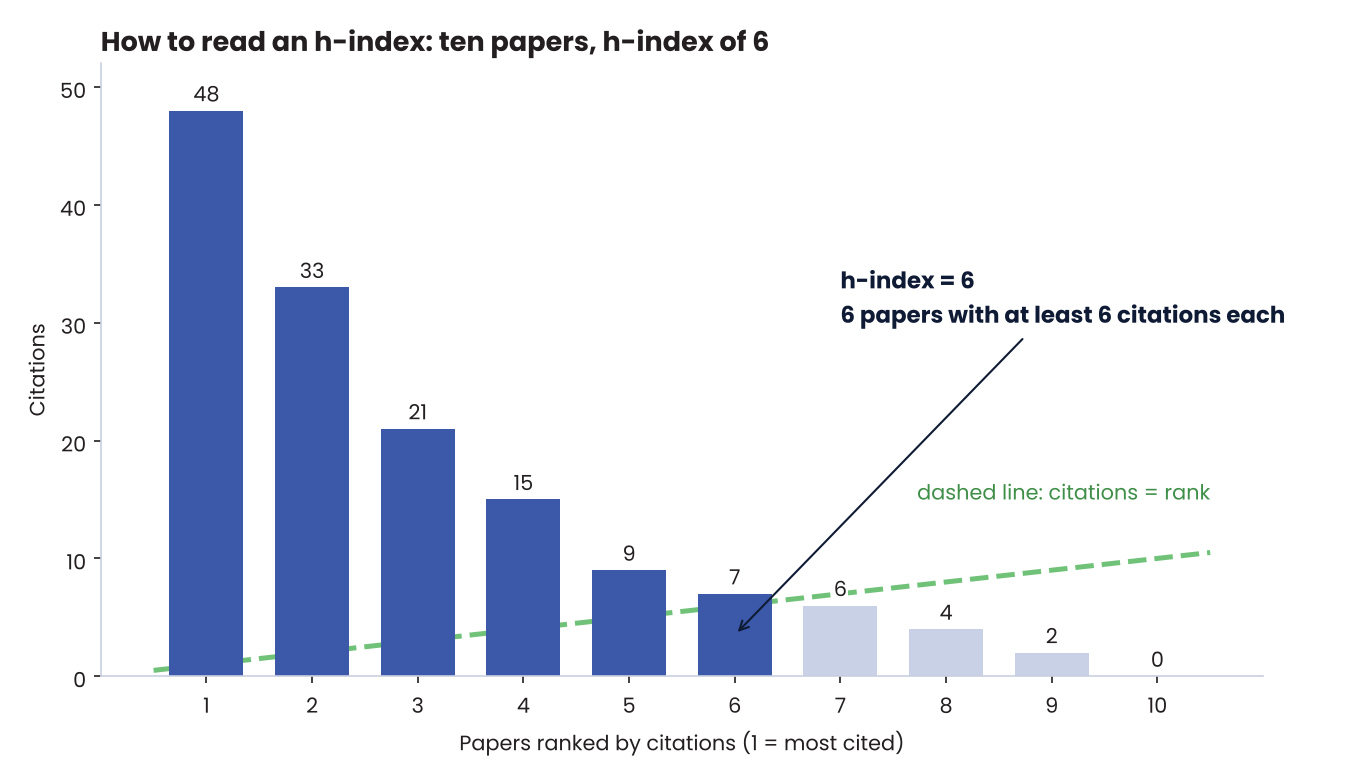
Two things follow from the method. First, the score can never be higher than the number of papers you have published. Second, citations above the threshold do not count. The paper with 48 citations adds exactly as much as the one with 7.
What is a good h-index in medicine?
There is no single cut-off, but published studies of academic physicians give useful reference points.
AVERAGE h-INDEX BY ACADEMIC RANK
2,429 academic surgeons, United States
Curated journal database. Source: Svider et al., Laryngoscope, 2013.
SAME PEOPLE, TWO DATABASES
299 emergency medicine professors, US and Canada
The middle half of professors ranged from 6 to 17 in the curated database, while in Google Scholar they ranged from 9 to 22.
Both studies cover US faculty and are more than ten years old. Values may have changed since, so use them as a rough guide, not as a cut-off.
Hirsch also gave benchmarks, though he based them on physicists. In his view, a score that grows by about one point per year marks a successful scientist, so 20 after 20 years. Two points per year (40 after 20 years) is outstanding, and three points per year marks truly unique scientists. He also suggested that around 12 might be typical for tenure and around 18 for a full professorship in physics.
Because career length drives the number, compare yourself with people at the same stage. Hirsch’s m-index does this for you: divide your score by the number of years since your first paper. An m-index close to 1 matches his “successful scientist” benchmark.
QUICK ANSWER
Is 27 a good h-index?
Compared with these two studies, yes. A score of 27 is above the average for full professors and department chairs in the surgery study. It is also above the top quarter of emergency medicine professors in Google Scholar.
If your first paper came out 27 years ago, your m-index is 1. If it came out 15 years ago, your m-index is 1.8, which is close to Hirsch’s “outstanding” level.
56
Einstein’s h-index
What is Einstein’s h-index?
Bibliometrics researchers Yves Gingras and Mahdi Khelfaoui counted 147 articles by Albert Einstein between 1901 and 1955. Counting citations up to 2019, his score is 56, according to their analysis.
Many active researchers today have a higher figure. That says more about the size of modern science than about Einstein’s work. It also shows why the number needs context.
Why your h-index differs from one database to another
Each database counts different documents. So the same researcher gets a different h-index on each one.
Usually highest
Google Scholar
Indexes almost anything online, including theses, preprints, books and conference abstracts. So it finds more citations.
Lower, more consistent
Curated journal databases
Index only selected journals, so they count fewer documents.
Depends on your profile
ScienceLeadR
Builds profiles from linked publications and clinical trials. Its count depends on the papers attached to your profile.
In the emergency medicine study above, the same professors had a median of 11 in a curated journal database and 14 in Google Scholar. So when you quote your h-index in a CV or a grant application, always name the database.
An h-index without its database is only half a number.
What a single number leaves out
The h-index is easy to read, which is why committees like it. But it leaves out a lot of what makes a strong clinical researcher.
01
It grows with career length. Researchers who have published for longer have had more time to collect citations. So it favours senior researchers and penalises early-career ones.
02
Authorship role does not count. A middle authorship on a 300-author consortium paper counts the same as a first or last authorship.
03
Fields differ. Hirsch himself noted that typical values vary by field. Larger fields, and fields with longer reference lists, also produce higher numbers.
04
People can inflate it. Self-citation and citation swaps raise the number without adding any real impact.
05
Clinical work stays invisible. Leading a trial, treating patients, teaching and supervising do not appear in the number.
The Leiden Manifesto for research metrics, published in Nature in 2015, makes the same point. Numbers should support expert judgement, not replace it, and they should account for differences between fields.
How to raise your h-index the right way
A low score can come from missing or split records rather than a lack of citations. So start with your records, then help your work get read.
FIRST, FIX YOUR RECORDS
- Merge your name variants. Papers published as “J. Smith”, “John A. Smith” and “Smith JA” often sit in separate author profiles. Ask each citation database to merge them, and merge duplicates in Google Scholar.
- Link everything to ORCID. An ORCID iD gives databases one identifier for your work. It helps them credit new papers to you rather than to someone with a similar name.
- Check that every paper is listed. Compare your profiles with your own publication list, and add anything missing, such as trial publications or older papers.
THEN, HELP YOUR WORK GET READ
- Make your work easy to find. Google lists your Scholar profile in its search results only if it is public and uses a verified institutional email, says its help page for Scholar profiles. Where your journal allows it, share the accepted manuscript too.
- Write the papers others need to cite. Researchers keep citing reviews, guidelines, consensus statements and multicentre trial results for years.
WHERE YOUR NEXT POINT COMES FROM
To move from 14 to 15, you need 15 papers with at least 15 citations each. So the papers ranked around 15th decide your next point. Make sure they are listed on your profiles and easy to find.
WHAT TO AVOID
Heavy self-citation, citation rings and honorary authorships can raise the number, but they add no real impact. Some databases let readers exclude self-citations, so an inflated score can show.
h-index vs SLR score
The SLR score that ranks experts on ScienceLeadR does not rely on the h-index. Instead, it measures recent, topic-specific activity.
| h-index | SLR score | |
|---|---|---|
| Time span | Whole career | Weighted toward recent work, so it reflects current activity |
| Topic | All papers together | Recalculated for each MeSH topic you search |
| Author role | Every authorship counts the same | First and last authorships weigh more |
| Clinical trials | Not counted | Counted; leading a multicentre trial as principal investigator equals ten articles |
| Citations | Total count | Citation pace per month, so recent papers are not penalised |
| Early career | Disadvantaged | Separate Rising Stars ranking for researchers with up to ten years of career |
Neither number captures your whole career. But together they show both long-term impact and current activity in a given field.
Frequently asked questions
What is my h-index in Google Scholar?
Open your Google Scholar profile. Your h-index appears in the box on the right, in two columns. “All” covers your whole career, while the “Since” column covers roughly the last five years. If you have no profile yet, create one with your institutional email address.
What is the i10-index?
The i10-index is the number of your papers with at least 10 citations. Google Scholar shows it next to your h-index, but it is simpler. It says nothing about how far above 10 your papers go.
Does ScienceLeadR use the h-index to rank experts?
No. ScienceLeadR ranks experts topic by topic with the SLR score, which weighs trials, author position, citation pace and recent work. You can see your position in the KOL rankings.
YOUR PROFILE ON SCIENCELEADR
Check that your publications are counted
Every metric depends on the list of papers behind it, and your ScienceLeadR profile is no exception. Find your profile, claim it, and sync it with ORCID to add any missing publications. Then select all the name variants you have published under, so your rankings reflect your full body of work.
External references and resources
- Hirsch JE. An index to quantify an individual’s scientific research output. PNAS. 2005;102(46):16569–16572.
- Svider PF, Pashkova AA, Choudhry Z, et al. Comparison of scholarly impact among surgical specialties: an examination of 2429 academic surgeons. Laryngoscope. 2013;123(4):884–889.
- Babineau M, Fischer C, Volz K, Sanchez LD. Survey of publications and the h-index of academic emergency medicine professors. West J Emerg Med. 2014;15(3):290–292.
- Gingras Y, Khelfaoui M. Why the h-index is a bogus measure of academic impact. The Conversation, republished by Social Science Space. 2020.
- Hicks D, Wouters P, Waltman L, de Rijcke S, Rafols I. Bibliometrics: the Leiden Manifesto for research metrics. Nature. 2015;520:429–431.
- Google Scholar. Google Scholar Profiles help.