 Written by
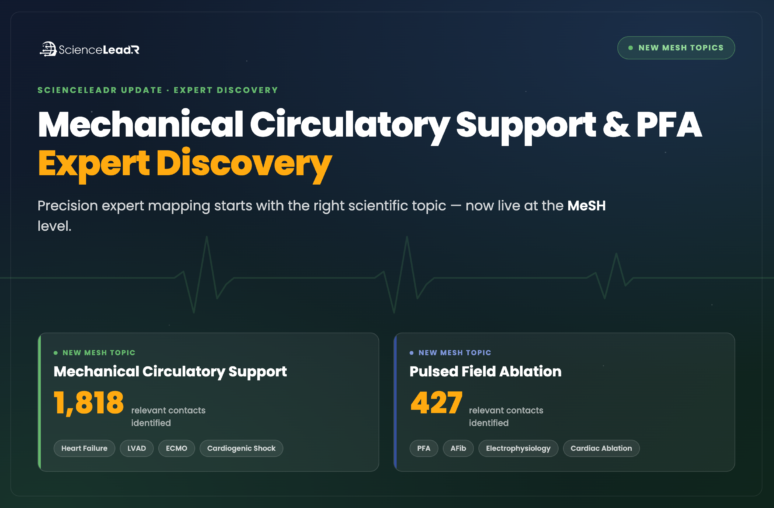
 Two new MeSH-based topics are now available in ScienceLeadR
These topics show why expert discovery in life sciences needs to move beyond broad specialties and generic KOL lists. The value is in finding the precise expert community connected to a specific medical question.
Mechanical Circulatory Support
A broad and multidisciplinary ecosystem spanning heart failure, cardiac surgery, intensive care, LVADs, RVADs, ECMO, cardiogenic shock, and advanced device-based therapy.
LVAD
MCS
Cardiogenic Shock
Pulsed Field Ablation
A focused and rapidly developing electrophysiology field linked to atrial fibrillation, cardiac ablation, rhythm management, mapping technologies, and next-generation MedTech innovation.
AFib
Electrophysiology
Cardiac Ablation
Why MeSH-level expert mapping matters
MeSH, or Medical Subject Headings, is a controlled vocabulary used to organize biomedical literature. For expert discovery, MeSH terms provide a structured way to move beyond simple keywords and identify scientific communities around precise medical concepts.
This matters because life sciences teams rarely need general experts. They need experts who are active in a specific indication, technology, procedure, patient pathway, or research question.
In Mechanical Circulatory Support
A MedTech, pharma, or academic team may need to identify clinicians and researchers active in LVADs, RVADs, ECMO, cardiogenic shock, advanced heart failure, cardiac surgery, and intensive care. The most relevant expert may not be the most visible cardiologist.
In Pulsed Field Ablation
A team working on PFA may need electrophysiology experts involved in atrial fibrillation ablation, cardiac mapping, rhythm management, ablation technologies, and clinical trial activity. In emerging MedTech areas, the expert landscape can change quickly.
The right expert is not always the most visible one. It is the one whose work is most relevant to the question you are asking.
From generic KOL lists to evidence-based expert communities
Traditional KOL mapping often starts with known names, personal networks, manual desk research, or broad database searches. That approach can miss highly relevant experts, especially in emerging or technically specific areas.
ScienceLeadR takes a different approach. The platform identifies expert communities using evidence-based signals from scientific activity, including publications, clinical trials, authorship roles, affiliations, and collaboration networks.
This makes it possible to map not only who is visible, but who is actually shaping the science around a specific topic.
Use cases for life sciences and MedTech teams
MeSH-level expert mapping supports high-value workflows across Medical Affairs, clinical development, scientific strategy, MedTech innovation, and academic collaboration.
Advisory board planning
Build a balanced board with the right scientific credibility, clinical experience, trial expertise, specialty diversity, and geographic coverage.
Trial site and PI selection
Identify investigators and institutions with relevant publications, clinical trial experience, patient access, and network position.
Scientific landscape monitoring
Track how fast-moving fields evolve as new publications, trials, institutions, and expert networks emerge.
Competitive intelligence
Support market access, publication planning, congress strategy, medical education, and targeted scientific engagement.
Better questions create better expert maps
Instead of asking, “Who are the top cardiologists?”, teams can ask more useful and more actionable questions.
- Who is publishing on pulsed field ablation in atrial fibrillation?
- Which experts are active in mechanical circulatory support trials?
- Which institutions are central to the LVAD and advanced heart failure network?
- Which emerging experts are gaining influence in electrophysiology?
- Which countries or regions show the strongest activity around this topic?
Precision is the difference
between a long list and the right list
In life sciences, more data does not automatically mean better decisions. A long list of names can create noise. A precise, evidence-based map creates direction.
ScienceLeadR helps life sciences, MedTech, pharma, biotech, and academic teams identify, evaluate, and monitor scientific experts using evidence-based signals from publications, clinical trials, and collaboration networks.
See the LinkedIn Highlight
ScienceLeadR also shared this update on LinkedIn, highlighting how MeSH-level expert discovery helps life sciences teams move from broad specialties to precise scientific communities in areas such as Mechanical Circulatory Support and Pulsed Field Ablation.