 Written by
 Overview
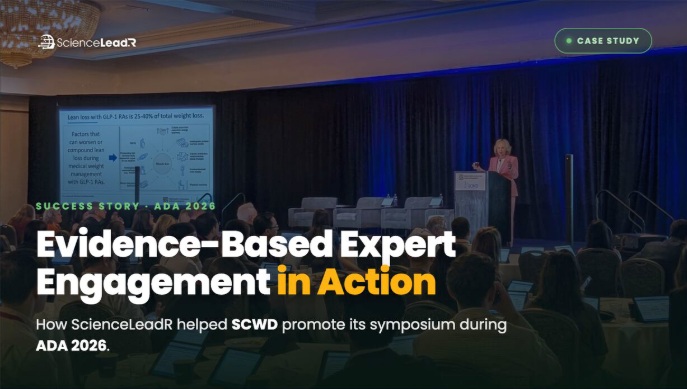
On 6 June 2026, the Society on Cachexia, Sarcopenia and Wasting Disorders held a symposium in New Orleans during ADA 2026. The symposium addressed body composition change in the era of incretin-based weight loss therapies.
To support awareness and attendance, SCWD partnered with ScienceLeadR to reach a highly relevant healthcare professional audience through targeted, evidence-based expert engagement.
Targeted expert community
More than 3,000 US endocrinologists with an interest in obesity were identified.
Personalized scientific outreach
The program was shared with tailored messaging focused on professional relevance and CME value.
Coordinated congress activation
ScienceLeadR outreach complemented SCWD tactics, including delegate bag inserts.
The Challenge
Finding the right audience
Precision matters in specialized medical education. The objective was not only to promote the symposium, but to reach healthcare professionals with clear relevance to the topic.
Scientific and medical education events are most effective when they reach professionals who are likely to benefit from the program.
For SCWD, the objective was to promote its symposium to healthcare professionals with a demonstrated interest in obesity, metabolic health, and related endocrine topics.
Rather than relying only on broad event promotion, the campaign required a precise approach: identify the right expert community, communicate the scientific relevance of the program, and support SCWD’s wider congress activation efforts.
The ScienceLeadR Approach
The campaign was structured around three coordinated plays: targeted community identification, personalized outreach, and multi-channel congress activation.
Targeted Community
ScienceLeadR identified a US-based community of more than 3,000 endocrinologists with a demonstrated interest in obesity.
Personalized Outreach
The symposium program was shared with messaging focused on clinical relevance, professional needs, and the benefits of CME accreditation.
Multi-Channel Activation
ScienceLeadR’s outreach complemented SCWD’s on-site promotional activities, including delegate bag inserts distributed during the congress.
The ScienceLeadR Approach
The campaign was structured around three coordinated plays: targeted community identification, personalized outreach, and multi-channel congress activation.
Targeted Community
ScienceLeadR identified a US-based community of more than 3,000 endocrinologists with a demonstrated interest in obesity.
Personalized Outreach
The symposium program was shared with messaging focused on clinical relevance, professional needs, and the benefits of CME accreditation.
Multi-Channel Activation
ScienceLeadR’s outreach complemented SCWD’s on-site promotional activities, including delegate bag inserts distributed during the congress.
Key Results
US endocrinologists identified with an interest in obesity.
Messaging focused on education value and clinical relevance.
Campaign aligned with congress activity in New Orleans.
Available symposium tickets sold.
Reaching the right experts is no longer only a question of scale. It is a question of scientific relevance.
Why It Matters
Medical and scientific communities are increasingly specialized. For societies, congress organizers, and medical education teams, the impact of a campaign depends on how precisely the audience is identified and how relevant the message feels to their professional priorities.
This case study shows the value of identifying experts based on their scientific and clinical interests, then communicating with them through messaging that reflects the real educational value of the program.
For SCWD, this approach helped connect a specialized symposium with a highly relevant audience of obesity-focused endocrinology professionals.
See the Campaign Highlight
ScienceLeadR also shared the campaign outcome on LinkedIn, highlighting the role of targeted expert engagement in supporting SCWD’s symposium promotion during ADA 2026.
Partnering for Evidence-Based Expert Engagement
ScienceLeadR helps scientific societies, medical education providers, and healthcare organizations identify and engage expert communities with precision.