

Claudio Babiloni
Claudio Babiloni is an expert in Psychology at IRCCS Ospedale San Raffaele (Italy). As of October 2026, ScienceLeadR ranks Claudio Babiloni in the top 1% of experts worldwide for Cognitive Dysfunction, Cognition Disorders and Alzheimer Disease. Claudio Babiloni has authored 528 publications, the most recent in 2026. SLR score: 1,763 (community average: 125). How the SLR is computed.
LeadR Profile
Psychology
Subspecialties: Neurology - Psychiatry
Main Topics
Publications and Clinical Studies
Profile data updated on
Expert Rankings
Top experts on the MeSH terms this expert works on
Short Biography
Name-Surname: Claudio Babiloni
CF: BBLCLD62C22H501L
Citizenship: Italian
Job position: Full Professor of Physiology (05/BIOS-06, BIOS-06/A)
Institutional Address: Sapienza University of Rome, Department of Physiology and Pharmacology “V. Erspamer”, P.le A. Moro 5, 00185 Roma, Italy
Office Phone Number: 0039 0649910941
E-mail: claudio.babiloni@uniroma1.it
Twitter: @BabiloniClaudio
Spoken Languages: Italian (mother tongue) and English
ORCID ID: 0000-0002-5245-9839
Web: https://dff.web.uniroma1.it/en.
Web: https://dff.web.uniroma1.it/it/laboratorio-di-neuroscienze-delle-funzioni-superiori-delluomo
Web: www.pdwaves.eu.
YouTube Channel: https://www.youtube.com/channel/UCJF6bAQkFcPFt8vHcLRy9-Q
Academic appointments
Received a Ph.D. in Biomedical Sciences (Aalborg University, Denmark) on June 1, 2001, and was appointed Associate Professor in Physiology on December 7, 2007, at the University of Foggia (Italy), served as Associate Professor in Physiology from December 27, 2012, to March 30, 2022, and as Full Professor in Physiology March 31, 2022, to date, at the Sapienza University of Rome (Italy).
Main scientific interests
Investigate the brain rhythms underlying the regulation of vigilance and consciousness levels, as well as cognitive functions, in the aging population. He is particularly interested in the abnormalities in that regulation in patients with the main progressive neurodegenerative diseases leading to cognitive deficits and dementia, such as Alzheimer's, Lewy body, and Parkinson's. The primary methods of this research are quantitative EEG and neuroimaging (mostly magnetic resonance imaging) techniques. He founded the international PDWAVES Consortium (www.pdwaves.eu) to promote this research line.
Scopus source (May 2025): 407 documents; 19,560 citations in 12,180 documents, H index of 78.
Organizations
Career arc: 1988 - 2026
Number : 528
Citations
Main journals
Best Journals
Breakdown by type
Click a legend label to hide or show it in the chart.
Latest Publications
5 most recent indexed articles
Source: Pubmed
LeadR Networks
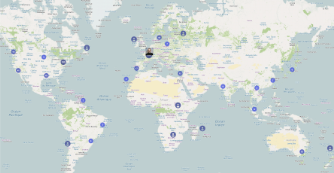
Main global connection map